In brief
- An off-the-shelf CRM is a rational choice when processes are close to standard and the primary goal is to quickly establish a consistent discipline for working with customers and deals.
- A custom CRM is justified when a key process cannot be represented safely and clearly through the configuration options of an off-the-shelf product, or when that process itself creates a competitive advantage.
- A hybrid option is often more practical than either extreme: a standard core can remain in place while unique operations are moved into integrations, separate modules, or a specialized working interface.
- Options should be compared by total cost of ownership, data quality, access control, integrations, and the cost of future changes—not only by the price of the initial launch.
The Choice Starts with the Business Process, Not the CRM
The question “which CRM should we choose?” comes too early. First, define the management outcome the system must deliver: preventing inquiries from being lost, moving deals through a consistent workflow, controlling documents, seeing team capacity, or consolidating reporting across several divisions. In its guidance on planning business applications, Microsoft likewise recommends starting with a concise description of the problem and desired outcome. Without this, any CRM demonstration becomes a tour of features whose value to the specific process is unknown.
Describe the current customer journey from the first contact until the company has fulfilled its obligations. Mark the participants, handoff points, required data, documents, external services, and decisions an employee must make. Then record the exceptions separately: a repeat inquiry, dispute, cancellation, refund, reassignment, or integration outage. Exceptions most often reveal whether a standard pipeline is sufficient or a specialized system boundary is needed.
- What event creates a customer, inquiry, or deal, and how the system recognizes a repeat inquiry.
- Which roles can view the record, change its status, approve an exception, and access financial fields.
- What data is mandatory at each stage and who is responsible for its accuracy.
- What actions take place on the website, in telephony, Telegram, email, the payment system, or the accounting product.
- Which reports are needed daily and which can be generated separately on request.
When an Off-the-Shelf CRM Is a Sensible Choice
An off-the-shelf CRM is suitable when the company is prepared to rely on a common model: lead, contact, company, deal, stages, tasks, communications, and standard reporting. In this case, the business receives not only an interface but also established core mechanisms for managing users and notifications. Many mature off-the-shelf CRMs offer mobile access, import, export, backups, and an integration catalog, but their availability and terms should be verified against the documentation and service-level agreement of the specific vendor. The team can focus on operating rules and data quality instead of building the infrastructure foundation.
But “off-the-shelf” does not mean “requires no implementation project.” You still need to configure entities, roles, fields, stages, and automated actions; clean the data; connect channels; train employees; and appoint a system owner. If you simply transfer the old spreadsheet and grant access, the CRM will reproduce the old chaos in a new interface. Savings appear only when the standard product genuinely covers the process without a constant struggle against its model.
- Most work fits into a standard sales or service pipeline.
- The company can adapt its internal rules to the product’s stable mechanisms.
- The necessary channels and accounting systems are already supported or have a documented API.
- The company accepts the licensing model, platform limitations, and the vendor’s update process.
- Unique operations can be implemented through a few clear extensions without a chain of fragile workarounds.
A good off-the-shelf CRM does not have to reproduce every habit of the company. It must support the target process without sacrificing control or concealing manual work.
Agentix Labs methodology
When a Custom CRM Is Justified
A custom CRM becomes a justified option when the system must represent a non-standard domain model and simplifying that model would create an operational or legal risk. The indicator is not the number of interface requests but the inability to describe the key operation accurately using standard entities and extensions. For example, a process may require several independent organizations, special rules for data ownership, controlled status transitions, server-side financial calculations, and validation of related documents.
Another argument is that the CRM effectively becomes the company’s operational product: employees use it not only to record a sale but also to deliver the service, manage infrastructure, calculate terms, maintain an audit trail, and support the customer. The limitations of an off-the-shelf platform can then push critical logic into spreadsheets, chats, and manual actions. A custom system makes domain rules part of the server-side layer and applies them consistently in the interface, API, and reports.
- A unique data model is part of the service itself, not merely a different way to present a deal record.
- Permissions depend simultaneously on the organization, office, role, record state, and related entities.
- Critical calculations and transitions must be controlled by the server rather than by user discipline.
- A single working interface is needed across several internal and external systems.
- The cost of years of workarounds and manual work exceeds the cost of maintaining a custom product.
The Third Option: An Off-the-Shelf Core with a Custom Layer
In practice, the choice is not limited to two extremes. Microsoft’s application modernization guidance notes that platforms with visual configuration and traditional development can be combined: the platform handles part of the workload while code provides the missing component. For CRM, this leads to several possible architectures. Contacts and sales can remain in an off-the-shelf system while complex calculations move to a separate service. A specialized workspace can interact with the CRM through its API. The platform can serve as the data foundation while domain-specific screens replace its standard forms.
A hybrid approach reduces the amount of custom infrastructure but requires clear boundaries of responsibility. Each entity is assigned a single source of truth. The direction of data exchange is defined for every event. Integration errors must be visible and handled repeatably instead of being corrected through unnoticed data copying. If two systems can independently change the same status or balance, the hybrid quickly becomes a collection of conflicting versions.
| Approach | Strength | Main Limitation | Best Fit |
|---|---|---|---|
| Off-the-shelf CRM | Mature standard core | The process must adapt to the product model | Operations are close to standard |
| Hybrid | Balance of speed and specialization | Requires strict integration boundaries | Only part of the process is unique |
| Custom CRM | Precise representation of domain rules | The company is responsible for development and operation | The CRM is a critical operational system |
How to Compare Total Cost of Ownership
The license price and the budget for a first version cannot be compared directly. For an off-the-shelf CRM, consider licenses by role, paid modules, integrations, implementation, migration, training, support, and possible plan changes as the team grows. For a custom CRM, consider analysis, development, infrastructure, monitoring, backups, fixes, security, documentation, and retaining expertise either in-house or with a contractor.
The calculation should cover the same time horizon and the same process. The model should include not only vendor payments but also internal time: manual data transfers, duplicate reconciliation, report preparation, workarounds, and employee support. At the same time, you should not automatically count every manual action as a saving after implementation: some checks may be deliberate control steps that should remain.
-
01
Define the Same Scope
Compare options using the same set of roles, scenarios, integrations, reports, and data requirements.
-
02
Separate Launch from Operation
Estimate implementation, recurring fees, support, development, and the cost of mandatory updates separately.
-
03
Calculate the Cost of Change
Determine how much effort a new role, channel, legal requirement, division, or stage change would require.
-
04
Include the Cost of Exit
Clarify the export format, migration of attachments and history, dependence on proprietary extensions, and the ability to change vendors.
Data, Integrations, and Permissions: Criteria That Determine the Choice
A CRM rarely works in isolation. It receives inquiries from the website and messengers, connects to email and telephony, sends data to an accounting system, receives payment statuses, and creates tasks. Before selecting a system, therefore, define not just the list of integrations but the owner of every entity and event. A contact, for example, may be created in the CRM, an order in the server-side component of the commercial system, and a payment confirmation only by the payment processor. The CRM reflects that event but must not invent it on its own.
Access permissions and audit trails should be evaluated separately. A role should receive only the actions and data it needs; hiding a button in the interface is insufficient if the operation remains available through a direct API call. NIST SP 800-53 describes access control and auditing as separate control families: a system should record the event type, time, source, result, and associated identity, and protect logs from unauthorized modification. Each company selects a specific set of controls based on its risks and applicable requirements.
| Criterion | What to Verify in a Demonstration or Pilot | Red Flag |
|---|---|---|
| Data | Export of entities, history, files, and relationships | Only a flat export without context is available |
| Integrations | API, webhooks, retries, and error log | Data exchange depends on manual reconciliation |
| Permissions | Role validation in both the interface and a direct request | Protection is limited to what is visible on the screen |
| Audit trail | Who changed a significant field, when, and how | A regular user can alter history without leaving a trace |
| Reliability | Backups, recovery, and monitoring | There is no tested recovery procedure |
Example: Why the Domain Model Can Outweigh an Off-the-Shelf Pipeline
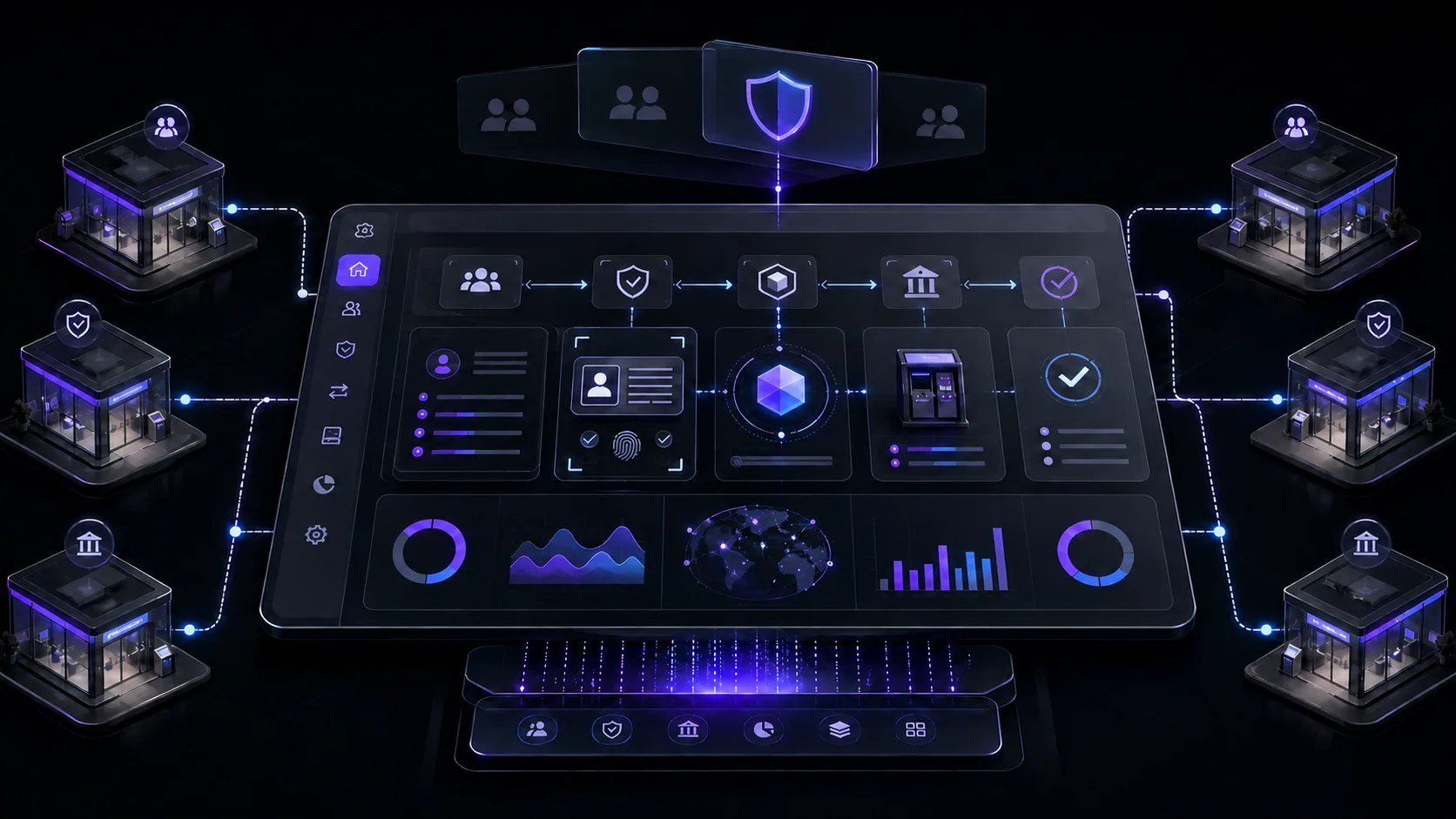
In the Agentix Labs Crypto Exchange CRM case, the system brings together customers, documents, deals, offices, cash desks, employees, and reporting for a network of physical cryptocurrency exchanges. Adding a few fields to a deal record is not enough here. The platform supports multiple organizations and determines each employee’s working context on the server, preventing one exchange’s data from becoming accessible to another through a manipulated filter, related record, or direct request.
Different roles have their own workflows. Cashiers and administrators work with the customers, documents, deals, and cash desks of their office, while the super administrator receives an organization-wide overview and consolidated reporting. Deal financial fields are calculated on the server, status transitions are controlled, documents are stored as private files, and the relationship between a file, the customer document, and the organization is verified before access is granted.
This case does not prove that every business needs a custom CRM. It illustrates the criterion: when data ownership, permitted actions, and calculations depend on several domain conditions, those rules must reside in a reliable server-side layer. An off-the-shelf platform is suitable only if it can represent such a model without numerous disconnected workarounds. Otherwise, a specialized system or hybrid layer provides a clearer architectural boundary.
- Key entities have an organizational owner.
- Related records are validated within the same working context.
- Reports reapply role restrictions on the server.
- The interface assists the user but is not the only layer of protection.
A Practical Selection Process in One Cycle
Selection is best structured as a short study with a demonstrable result rather than a series of vendor presentations. The working group should include the process owner, representatives of the main roles, a data specialist, and the person responsible for integrations or operations. Their task is to agree on the target process and test every option against the same scenarios.
-
01
Describe the Problem and Boundaries
Define the outcome, roles, entities, integrations, exceptions, and what is explicitly outside the first launch.
-
02
Separate the Requirements
Mark mandatory conditions, useful improvements, and ideas for the future. Every mandatory requirement must have a verification method.
-
03
Prepare Three Architectural Options
Compare an off-the-shelf CRM, a hybrid, and a custom system using the same matrix without tailoring the criteria to a preferred candidate.
-
04
Run a Scenario-Based Pilot
Perform real operations with anonymized test data, including an integration error, duplicate, role change, and export.
-
05
Record the Decision
Document the selected system boundary, reasons for rejecting the alternatives, assumptions, total cost of ownership, and conditions for reconsidering the decision.
A pilot should not attempt to recreate the entire future product. It is enough to test the riskiest assumptions: whether the domain model can be represented, the quality of the API, role separation, data export, and one end-to-end process. If the main risk remains untested, an attractive pilot interface does not make the decision safer.
Final Decision Matrix
For the final choice, rate every option on a consistent scale and attach evidence to each score: a pilot result, a documentation section, a calculation, or an architectural diagram. The business assigns each criterion’s weight before evaluating candidates. For regulated or financially significant processes, access, audit trails, and data integrity may matter more than interface convenience; for a standard sales department, implementation speed and ready-made channels may be decisive.
- Fit with the core process and handling of exceptions.
- Management of roles, organizations, and sensitive data.
- Integrations, source of truth, and reliable reprocessing of events.
- Migration of current data and the ability to make a complete exit from the system.
- Total cost of launch, operation, and changes.
- A product owner, support, and a clear development process.
If an off-the-shelf product passes all mandatory scenarios and the business accepts its model, custom development will usually add unnecessary responsibility. If a key process remains outside the platform, it should not be concealed behind dozens of manual procedures. A hybrid should then be tested. A custom CRM becomes a deliberate product decision only when the unique layer genuinely covers a significant share of the work and requires a unified domain model.
Frequently asked questions
Which Is Cheaper: an Off-the-Shelf or Custom CRM?
There is no universal answer. An off-the-shelf CRM requires licenses, configuration, integrations, and support; a custom CRM requires development, infrastructure, maintenance, and ongoing evolution. Compare the same functional scope over the same time horizon, including internal manual work and the cost of exit.
Can We Start with an Off-the-Shelf CRM and Move to a Custom One Later?
Yes, provided you establish high-quality data, clear identifiers, documented exports, and integration boundaries from the start. The more critical logic is hidden in opaque extensions, the harder the eventual migration becomes.
When Is a Hybrid Approach the Better Choice?
When standard contacts, deals, and communications are well covered by an off-the-shelf product but a specific operation requires custom logic or an interface. A hybrid must define the source of truth for every entity and the rules for handling data exchange errors.
How Can We Tell Whether a Process Is Truly Unique?
Check whether the domain model and decision rules themselves differ, rather than merely field names and the familiar placement of buttons. Uniqueness should appear in mandatory scenarios, permissions, calculations, integrations, or state control.
Where Should We Start When Choosing a CRM?
Start with a concise description of the business problem, desired outcome, and end-to-end process. Then prepare testable scenarios, a role matrix, and a list of data and integrations, and run the same pilot for off-the-shelf, hybrid, and custom options.
Sources
- Microsoft Learn: Identifying the Business Problem to SolveChecked 30 July 2026
- Microsoft Learn: Modernize Applications with Power PlatformChecked 30 July 2026
- NIST SP 800-53 Rev. 5: Security and Privacy Controls for Information Systems and OrganizationsChecked 30 July 2026